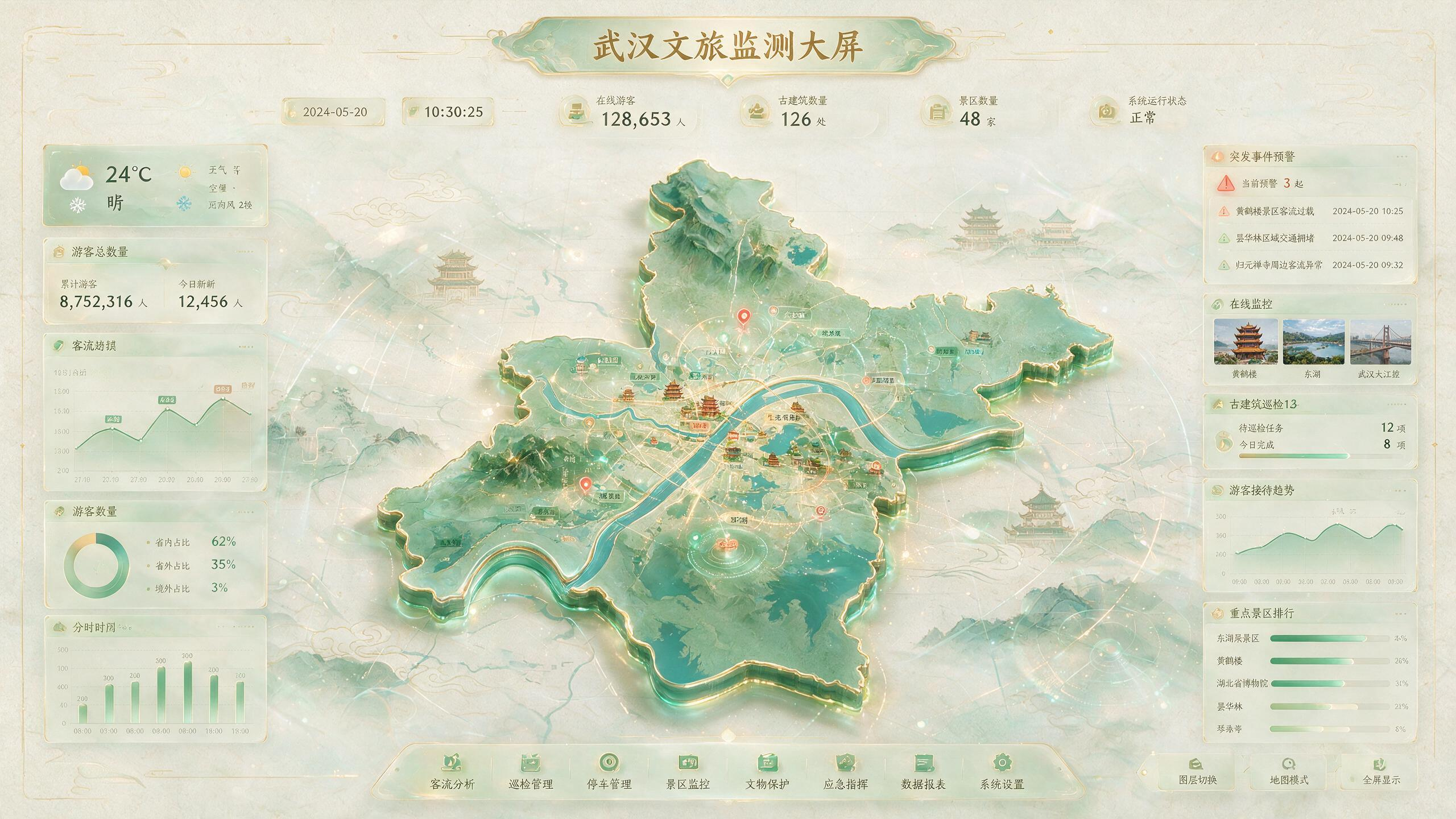
Enterprise Smart Cultural Tourism Jiangcheng Monitoring Cockpit AI Image Prompt
Enterprise-grade smart cultural tourism Jiangcheng monitoring cockpit, 16:9 horizontal composition, integrating smart cultural tourism, digital twin GIS, new Chinese aesthetics, and historic city preservation. The overall design adopts a light high-end UI style with off-white, celadon green, jade green, lake blue, and champagne gold as the main color palette. The background blends rice paper texture, ink wash landscapes, auspicious cloud patterns, silhouette of ancient architecture, subtle digital grids, and soft glows, creating a visual atmosphere that merges modern technology with Eastern Jingchu culture. The center of the screen displays a high-precision 3D GIS map of Wuhan city, presenting the layout of Wuhan's three towns and the Yangtze River and Han River water systems, using real administrative boundaries, slight DEM relief terrain, multi-layer stereoscopic slice structures, and a floating digital base. The map uses a gradient of celadon green, jade green, and light lake blue, with glowing cyan-green and champagne gold outlines on the borders. Key cultural tourism resources are labeled internally, including Yellow Crane Tower, East Lake Scenic Area, Hubei Provincial Museum, Guqin Terrace, Qingchuan Pavilion, Wuhan Yangtze River Bridge, Tanhualin, Hankow Customs House, and Guiyuan Temple. The map overlays red and cyan scenic spot location markers, tourist heat zones, ancient building protection points, tourist routes, curved passenger flow connection lines, radar scan rings, dynamic particles, and data labels, forming a smart cultural tourism digital twin scene. At the top, the title "Wuhan Cultural Tourism Monitoring Screen" is set in a new Chinese-style scroll plaque shape, with flying eaves, auspicious clouds, and fine gold lines on both sides, and displays KPIs such as date, time, online visitors, number of ancient buildings, number of scenic spots, and system operation status. The left side lays out modules for real-time weather, total visitors, passenger flow trends, visitor origins, bar charts, and donut charts; the right side lays out emergency alerts, real-time surveillance video, ancient building inspection tasks, visitor reception trends, top scenic spots ranking, and statistical cards; the bottom sets function buttons for passenger flow analysis, inspection management, parking management, and map mode switching. The overall UI adopts light glassmorphism, jade texture cards, semi-transparent interfaces, champagne gold thin borders, soft rounded corners, HUD tech elements, digital scales, thin line separators, and plenty of white space. Lighting uses HDRI ambient light, Bloom glow, AO ambient occlusion, volumetric light, map edge glow, digital particles, and cinematic reflections, giving the overall enterprise-class smart cultural tourism platform quality. Style references: Huawei Digital Twin, Alibaba Cloud DataV, Tencent WeCity, ArcGIS Dashboard, Apple Vision Pro UI, Microsoft Fluent Design, Song Dynasty aesthetics, new Chinese UI, Dribbble, Behance, smart cultural tourism, historic city conservation, digital government, cultural tourism GIS, Jiangcheng cultural tourism, enterprise-level FUI, PBR materials, HDRI rendering, Ultra Detailed, Professional Dashboard, 8K.
Content: Formula: subject+scene+style+composition+color+material+lighting+UI layout+style refs. Elements: 16:9, light UI, new-Chinese+tech, 3D GIS map, Wuhan tourism data modules.
Pros: Rich details, clear fusion of scene and style.
Cons: Verbose, may over-constrain generation.
Reference image: No obvious reference-image dependency
Source materials are collected from publicly accessible web pages. Contact us if a rights issue needs review. Copyright & Privacy