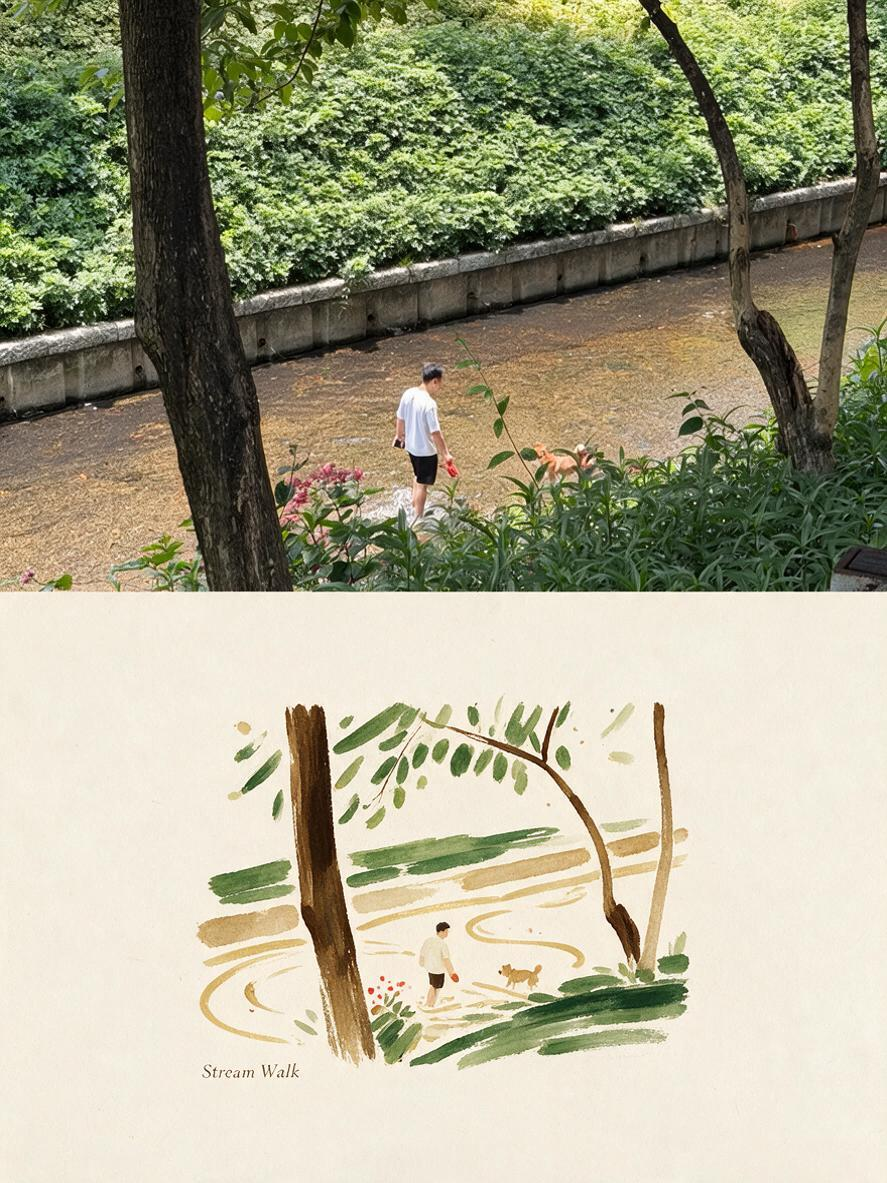
Real-Scene Photography and Visual Deconstruction Diptych AI Image Prompt
Transform the user-uploaded photo into a top-and-bottom diptych poster of “real-scene photography + visual deconstruction.” Use a 3:4 vertical format, strictly divided equally along the horizontal center line: the upper 50% is the original photographic image, and the lower 50% is a warm ivory-white paper surface. First identify people, animals, and core subjects, establish a complete protected area, and preserve space for heads, limbs, contact points, and direction of action; adjust the scaling and position of the original image according to visual weight, prioritize cropping out secondary background, naturally extend the environment when necessary, and make the upper half full-bleed with the subject intact. The lower half does not scale down the original scene; instead, it deconstructs the visual grammar of the original image: extract one main axis, 2–4 main contours, light-dark proportion, repetition rhythm, spatial direction, and 3–5 representative colors, then reorganize them into an independent abstract composition. The subject is transformed into shape relationships: towers and eaves become layered, suspended horizontal arcs and vertical axes; woods become long and short brushstrokes with varying density; roads, rivers, and light trails become curves traversing the image; buildings become offset geometric blocks; crowds and balloons become color dots of different sizes and varying clustering/spreading; sunset and horizon become multi-layered color bands and tiny breaks. Retain the most critical proportions, directions, rhythms, and color relationships of the original image, so that the upper and lower images echo each other structurally, while the lower part has a new order and space for imagination. The abstract image occupies 50%–68% of the width and 38%–55% of the height of the lower half, composed of 8–18 shapes of clearly different sizes, including a primary shape, secondary shapes, connecting lines, gaps, and one small unexpected brushstroke; the composition allows separation, offset, suspension, repetition, cutting, and large areas of negative space, creating visual tension. Colors are sampled directly from the original image, composed of 1 main color, 2 auxiliary colors, and 1 small-area accent color; after mixing with paper white, they present a matte gouache, colored-pencil, or dry-brush texture, retaining slight tonal variation, layered color, and handmade rough edges. Below, pair it with a 2–5-word English poetic phrase, set in a small classical serif font below the abstract image or in the lower-left corner, responding only to scenery, actions, and atmosphere confirmable in the original image. When multiple photos are input, generate one poster of the same series for each, uniformly maintaining 50% photography and 50% visual deconstruction.
Content: Formula: 3:4 vertical diptych; top original photo with subject protection; bottom extracts axis, contours, light-dark, rhythm, direction, palette into abstract shapes; limits abstract size, shape count, color, texture, type; multi-image series.
Pros: Clear roles; quantified constraints on color, shapes, text keep series consistent.
Cons: Depends on source composition and subject recognition; dense rules may reduce creativity.
Reference image: Clearly depends on user-uploaded/original image.
Curated from publicly available creative examples. Prompts and commentary are edited and organized by this site. Please contact us with any rights concerns. Copyright & Privacy