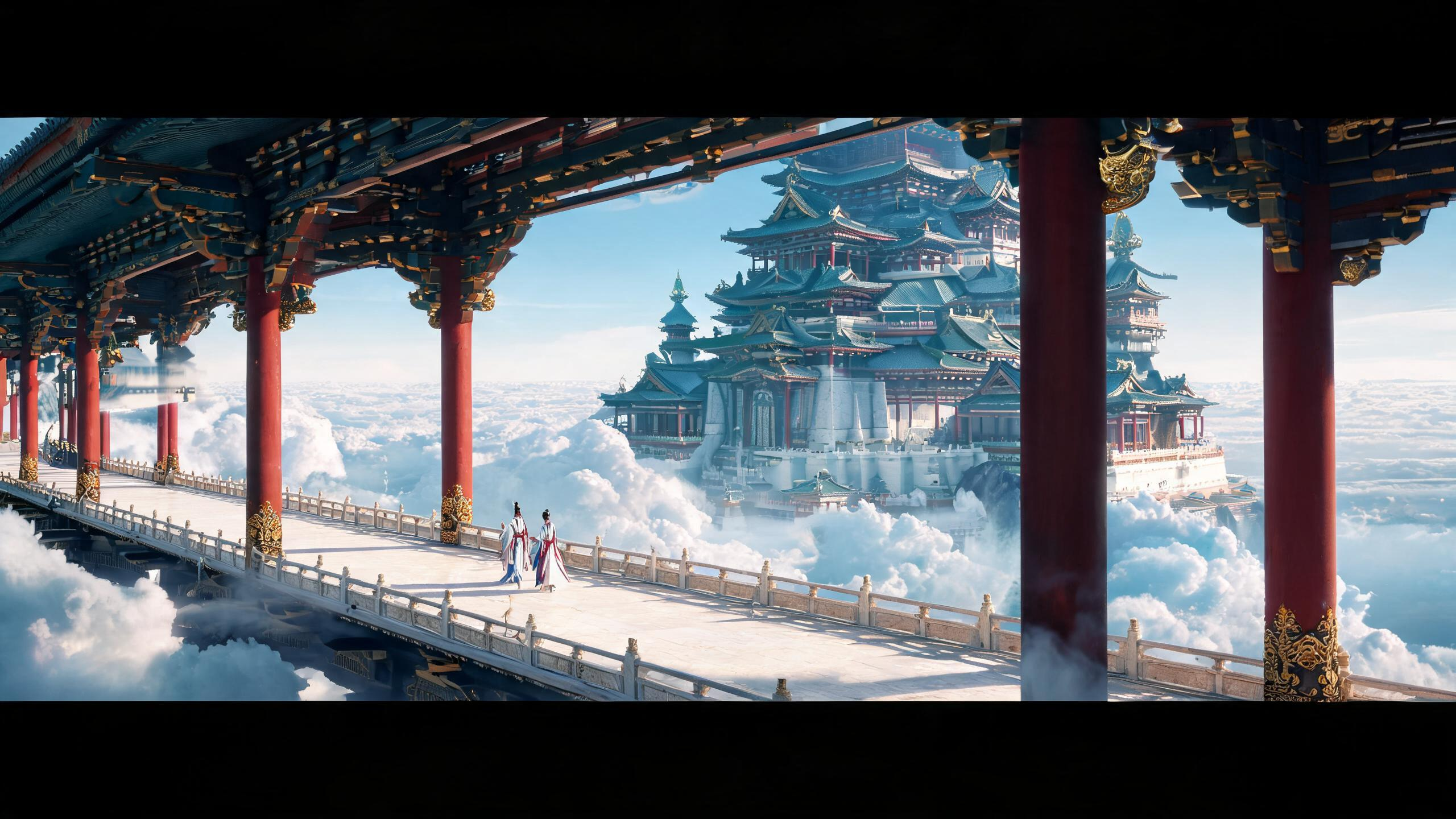
Eastern Divine Architecture: Giant Bridge and Distant Palace AI Image Prompt
Oriental divine realm architectural civilization photography, large-format cinematic texture, 70mm medium telephoto lens f/8, eye-level slightly looking up, telephoto compression. Camera positioned on another side platform or bridge end, at human eye height 1.4 meters. In the foreground, a monumental sky-crossing bridge spans the middle of the frame — white jade base, deep vermilion body, ink-blue eaves, ancient gold node decorations. The bridge is massive like a habitable palace corridor, with both ends cropped out of frame, occupying 40%-50% of the vertical composition. The bridge deck is broad, with smooth flawless white jade surface; deep vermilion pillars repeat at equal intervals extending toward vanishing points on both sides, with ink-blue dougong and flying eaves details visible between pillars. The bridge body bears overwhelming horizontal weight. Below the bridge is a vast high-altitude abyss and churning sea of clouds — nearby clouds are voluminous, fluffy, and thick; distant clouds merge into a quiet and boundless white cloud plain. At the far distance, suspended at the other end of the sky, is the lone ultimate sovereign — the core divine palace of the main city, at city/mountain scale, still occupying about 33% of the frame height across several kilometers of space. The 70mm telephoto lens "pulls closer" the distant palace, making it appear nearer, more massive, and more oppressive than its actual distance. The main palace features a medium-deep cyan-gray body, dark indigo-ink double eaves, dark vermilion structures, warm white jade base, and restrained gold gilding, horizontally broad like a mountain range, clearly outweighing the foreground giant bridge. 2-3 extremely small Eastern immortals walk on the bridge, wearing white-blue Hanfu with wine-red ribbons, their figures only about 1/8 of the pillar height, slowly walking toward the distant main palace. Scale evidence: ① The bridge spans the frame like a habitable palace corridor, cropped at both ends. ② The immortals on the bridge are only a tiny fraction of the pillar height. ③ The 70mm telephoto compression makes the main divine palace several kilometers away still as huge as a mountain, occupying 33% of the frame. ④ The repeating pillars extending to the vanishing point establish the bridge's length. ⑤ The foreground giant bridge and the distant main city create a dual giant scale — "the bridge is already a palace, yet the main city is even more massive." Five layers of space: ① Giant horizontal bridge (cropped, foreground weight) → ② Immortals on bridge (scale reference) → ③ Sea of clouds and abyss below bridge → ④ Distant main divine palace (ultimate giant) → ⑤ Clear sky above the main palace. Lighting: bright and clear, high visibility. Clear warm golden side light from the left in the afternoon illuminates the white jade bridge surface, gilded nodes, and lacquer brightly but without overexposure; shadows retain cool blue layers. The main divine palace is slightly cyan-gray due to aerial perspective but maintains a medium-deep color mass, clearly darker than the sea of clouds and not to be whitewashed. Color: ivory white bridge deck + deep vermilion bridge body + ink-blue eaves + ancient gold nodes → pure
Content: Structure: subject (Oriental divine architecture) + scene (cloud sea abyss) + composition (cropped bridge foreground, distant palace) + lens (70mm telephoto compression) + lighting (side light) + color (white jade, vermilion, etc.) + scale evidence and five-layer spatial hierarchy.
Pros: Reinforces monumental feel via multiple scale contrasts; specific lighting and color settings.
Cons: Too many elements may limit generation freedom; some descriptions repeat.
Reference image: No obvious reference-image dependency
Source materials are collected from publicly accessible web pages. Contact us if a rights issue needs review. Copyright & Privacy