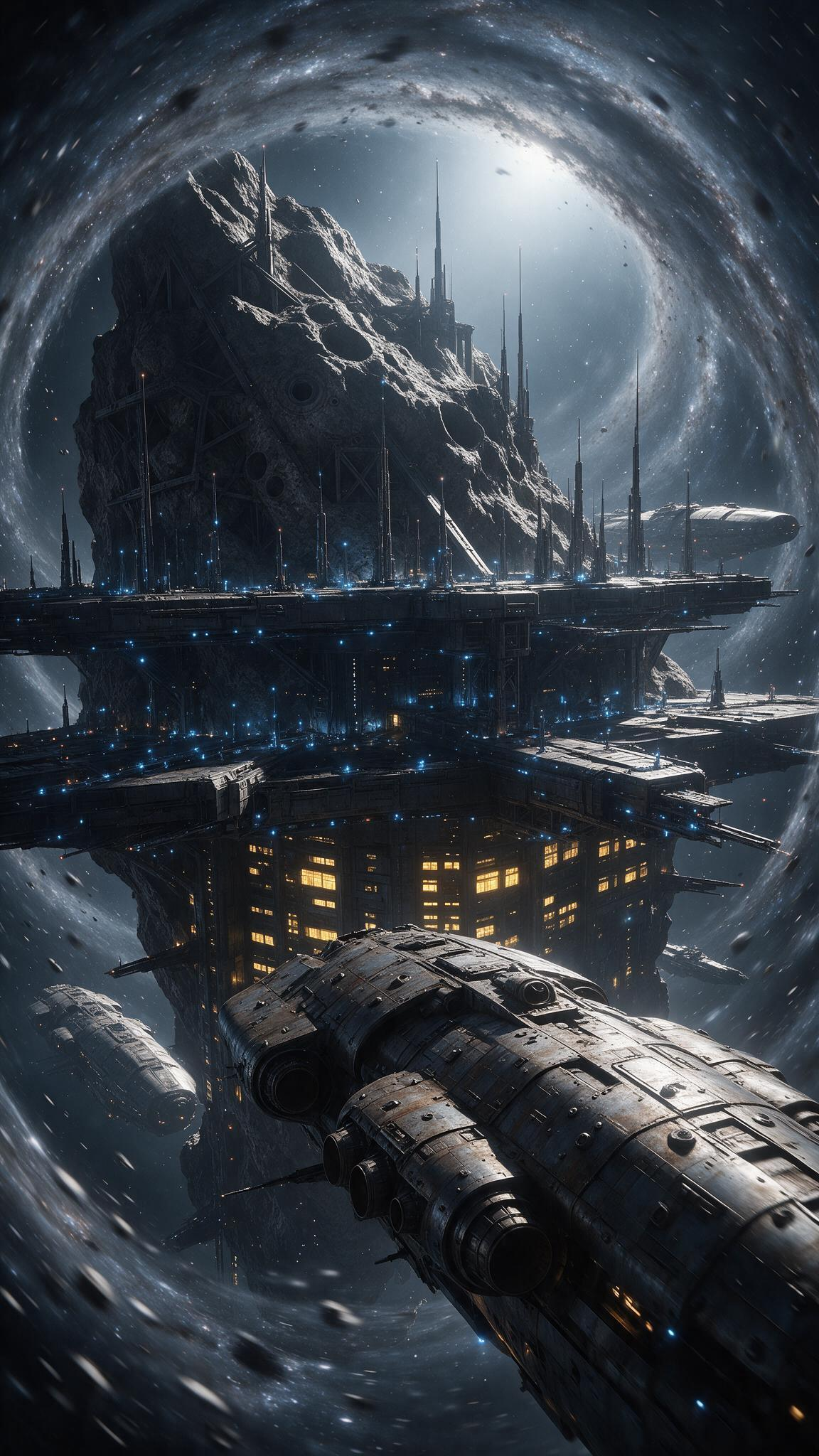
Asteroid Starport with Cargo Freighter AI Image Prompt
Realistic cinematic photography, vertical 9:16, 24mm wide-angle. The camera has just burst out at high speed from the narrow gap of a rotating nebula, the field of view suddenly opening out of chaos — a giant interstellar port clinging to a kilometer-scale irregular asteroid crashes head-on into the frame. Camera at mid-height of the port, slightly low-angle three-quarter view, close range; not an aerial panorama. Subject: The port core on the asteroid's front face occupies about two-thirds of the upper-middle of the frame. Gray-black rock is exposed and visible; metal platforms, suspended flight corridors, docks, cranes, pipelines, and spires are embedded directly into the rock face. Between the rock and the artificial structures, drilled holes, anchor beams, and support trusses are visible — the port truly grows on the rock rather than floating. Foreground giant ship: A massive cargo interstellar freighter extends diagonally in from the lower right, its bow very close to the lens, occupying about one-third of the lower half, partially cropped by the frame, strong perspective pressing toward the viewer. In the distance, two more giant ships of different scale are docked outside the port, partially occluded. Port hierarchy: Three to four giant horizontal platforms form the main structure; dozens of recognizable spires, docking bays, and cranes grow out from between the platforms. Cold blue navigation lights form a winding river of light along the building edges, guiding the eye deep into the port. Materials: oxidized blackened metal plates, rivets, exposed weld seams, heat-discolored armor seams, micrometeorite pits, frost, oil stains, peeling coatings, patched steel plates. Different components show differences in age and level of maintenance — not uniformly smooth new metal. Light and color: Primary colors black / silver-gray / deep blue. Cold white light from the nebula gap cuts in from the upper rear, rimming the rock ridges, ship edges, and spire silhouettes. Cold blue navigation lights form a winding river of light along the building edges. Deep in the port there must be dim warm yellow light — below the mid-ground platforms, in shadowed areas, densely and repeatedly arranged square windows emit warm yellow light (#E8C060), like a honeycomb full of people; the warm-light area occupies about 15% of the dark portion of the frame. Warm lights and cold blue navigation lights coexist without covering each other. Sense of speed: The port, ships, and main buildings stay sharp. Only the nebula gap edges, nearby cosmic dust, and a few fragments streaking past the lens at high speed produce radial motion blur. The peripheral nebula forms an incomplete vortex frame without blocking the port core. Avoid: aerial panorama, port subject too small, symmetrical poster, smooth plastic spaceship, full-frame motion blur, blue neon only, all-cold tones with no warm lighting, no window lights, clean new metal, cartoon CG.
Content: Formula: asteroid port subject + foreground freighter + port hierarchy + materials + light/color + speed cues, plus an avoid list. Vertical 9:16, 24mm wide-angle, mid-low three-quarter low angle; cold blue base with ~15% warm window light, edge-only radial blur.
Pros: Concrete hierarchy and material detail; explicit warm/cool light ratio.
Cons: Very dense, elements may compete; numeric ratios are hard to control exactly.
Reference image: No obvious reference-image dependency
Curated from publicly available creative examples. Prompts and commentary are edited and organized by this site. Please contact us with any rights concerns. Copyright & Privacy