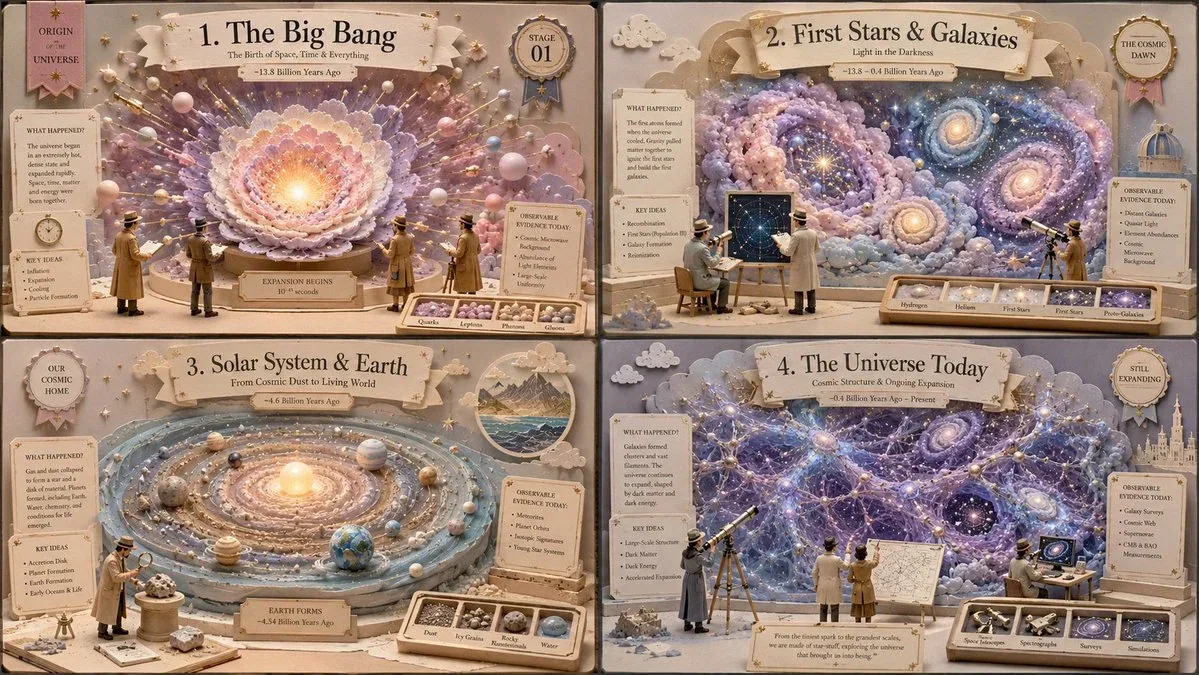
Four Stages of Universe History in Museum Miniature AI Image Prompt
2x2 grid, 16:9, 4 stages of the history of the universe: a = { soft museum diorama: matte clay, plaster, pastel resin, ceramic, paper props, gentle museum glow } b = { discovery moment: breakthrough scene of [Subject], frozen in sculptural miniature, tiny observers and tools } c = { educational staging: plaques, labels, specimen trays, books, instruments, numbered captions } d = { souvenir poster layer: paper-cut title, badges, ribbons, landmark icons, soft cutout clouds, paper texture } e = { palette: cream, blush pink, pale lavender, powder blue, mint, warm gold } exhibit = (a ∩ diorama_base) ∪ (b ∩ core_scene) ∪ (c ∩ info_layer) ∪ (d ∩ poster_overlay) ∪ (e ∩ color_constraint) Render [Subject] as this composite: - the subject's silhouette is transformed into a smooth pastel sculptural centerpiece. - tiny figures in period dress observe, sketch, or document the breakthrough. - display plaques with elegant serif captions. - a layered poster-style title floats above, with soft paper-cut badges. - soft shadows, dreamy atmosphere, macro view, 8k.
Content: Combines five element sets via set operations: subject silhouette (a∩b), miniature scene (b), educational layer (c), poster overlay (d), unified pastel palette (e). Final result is a 2x2 grid museum diorama with macro view, soft glow, and 8K detail.
Pros: Clear structure with replaceable [Subject] placeholder; consistent color and material constraints ease style control.
Cons: Set-notation formula may confuse beginners; layering complex elements requires careful spatial management.
Reference image: No obvious reference-image dependency
Source materials are collected from publicly accessible web pages. Contact us if a rights issue needs review. Copyright & Privacy