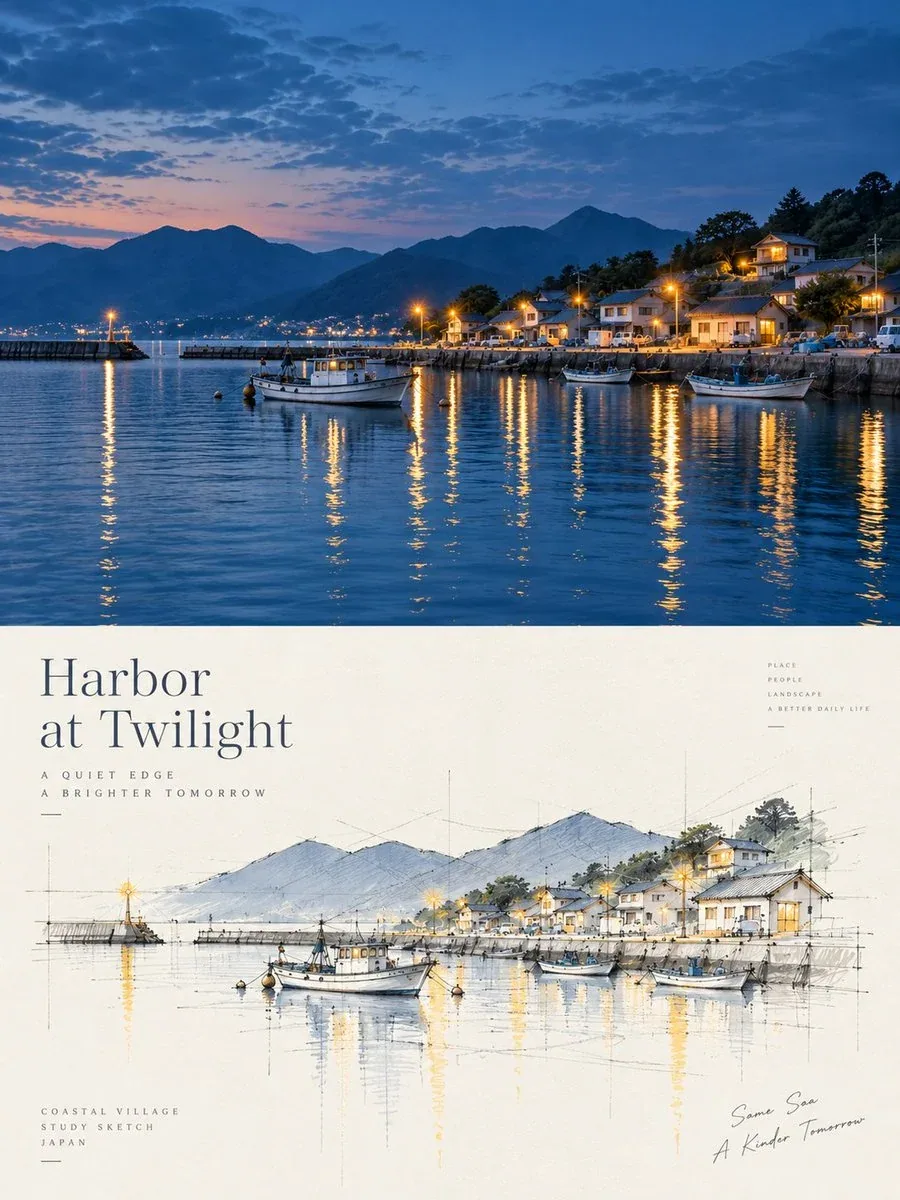
Architectural Concept Hand-Drawn Poster, 1:1 Split with Negative Space AI Image Prompt
Create each uploaded photo as a separate high-end design poster, no multi-image collage. Overall use a 3:4 vertical composition, with the upper and lower areas exactly 1:1 in height, each occupying 50% of the frame. The upper half retains the original photo, preserving the subject's identity, structure, pose, realistic texture, natural lighting, and original color atmosphere, with only slight high-end color grading to give it the texture of an art magazine and exhibition image. To fit the format, the environmental background may be naturally extended, but the subject must not be stretched, distorted, or altered. The lower half extracts only the most recognizable subject, silhouette, structure, pose, and narrative relationship from the photo, reconstructing them as an architectural concept perspective sketch / hand-drawn architectural scheme presentation. Do not retain the complete scene, and do not copy objects one by one from the photo; actively remove most of the background, surroundings, and irrelevant details, leaving only the core form, spatial relationships, and visual memory points that best represent the original theme. The lower half requires a new artistic judgment. Even if the original composition is poor, the background is messy, and the subject is small, it must be saved into a resolved artwork through reduction, reorganization, cropping, scale changes, and negative space, truly giving the model the power to re-direct the image. The style uses freehand perspective line drawing + a small amount of selective color blocking. Lines are relaxed, restrained, with a slight sense of repetition and pause; a small number of auxiliary lines, extension lines, construction lines, and geometric reference lines of architectural hand drawing may be retained, forming a clear sense of design exploration. Color is applied lightly only in a few key areas to emphasize the subject, structural hierarchy, local shadows, or spatial focal points, while the rest of the area is left mostly unpainted. The image must center on a large amount of intentional negative space. The subject should be smaller and more refined, with the remaining space largely left empty. Negative space is not an empty background but part of the composition; together with the subject, line drawing, reference lines, shadows, and a small amount of color blocking, it should create a sense of breathing, spatiality, and rhythm. The subject may be off-center, edge-aligned, partially cropped, or reduced in scale; it is better to draw less than to fill the frame. A small number of geometric shadow color blocks may be added to strengthen volume, depth, and spatial layering, but avoid heavy rendering, complex environments, and realistic rendering-image feel. Keep the background extremely minimal, retaining only a very small amount of necessary site suggestion. Extract 2–4 of the most recognizable and vital colors from the photo above and reorganize them into a cleaner, more restrained, more enduring sketch palette. Overall, it may be moderately brightened, purified, and de-grayed, mainly using off-white, light gray, warm gray, soft green, pale wood, light blue-gray, etc., with a small amount of more vivid but not harsh accent color retained locally. Avoid dirty gray, dullness, excessive vintage, and cheap high-saturation feel. Text should be used only as a very small editorial intervention, with no language restriction. Based on the subject, place, action, or emotion, generate a small number of words, short phrases, or annotations, quietly placed in the negative space, forming a restrained text-image relationship with the composition. The overall presentation is a high-end visual effect composed of architectural concept hand drawing, free line work, geometric reference lines, a small amount of color blocking, geometric shadows, an extremely large amount of negative space, and editorial layout. Avoid retaining the complete scene, copying objects one by one, complex backgrounds, full-frame coloring, realistic rendering images, heavy outlines, cartoon feel, 3D feel, and template-like expression.
Content: Formula: 3:4 vertical, top/bottom 1:1; top keeps original photo with light grading, bottom abstracts subject into architectural concept sketch. Style: freehand linework, selective color blocks, geometric guide lines/shadows, large negative space, editorial layout. Palette: 2–4 colors from photo, off-white/light gray/warm gray, avoid saturation.
Pros: Clear split composition and strong negative-space direction; style instructions are specific.
Cons: Depends on uploaded photos; text intervention may be unpredictable; lower-half reconstruction can drift from subject.
Reference image: Obvious dependency on uploaded photos and reference images.
Source materials are collected from publicly accessible web pages. Contact us if a rights issue needs review. Copyright & Privacy