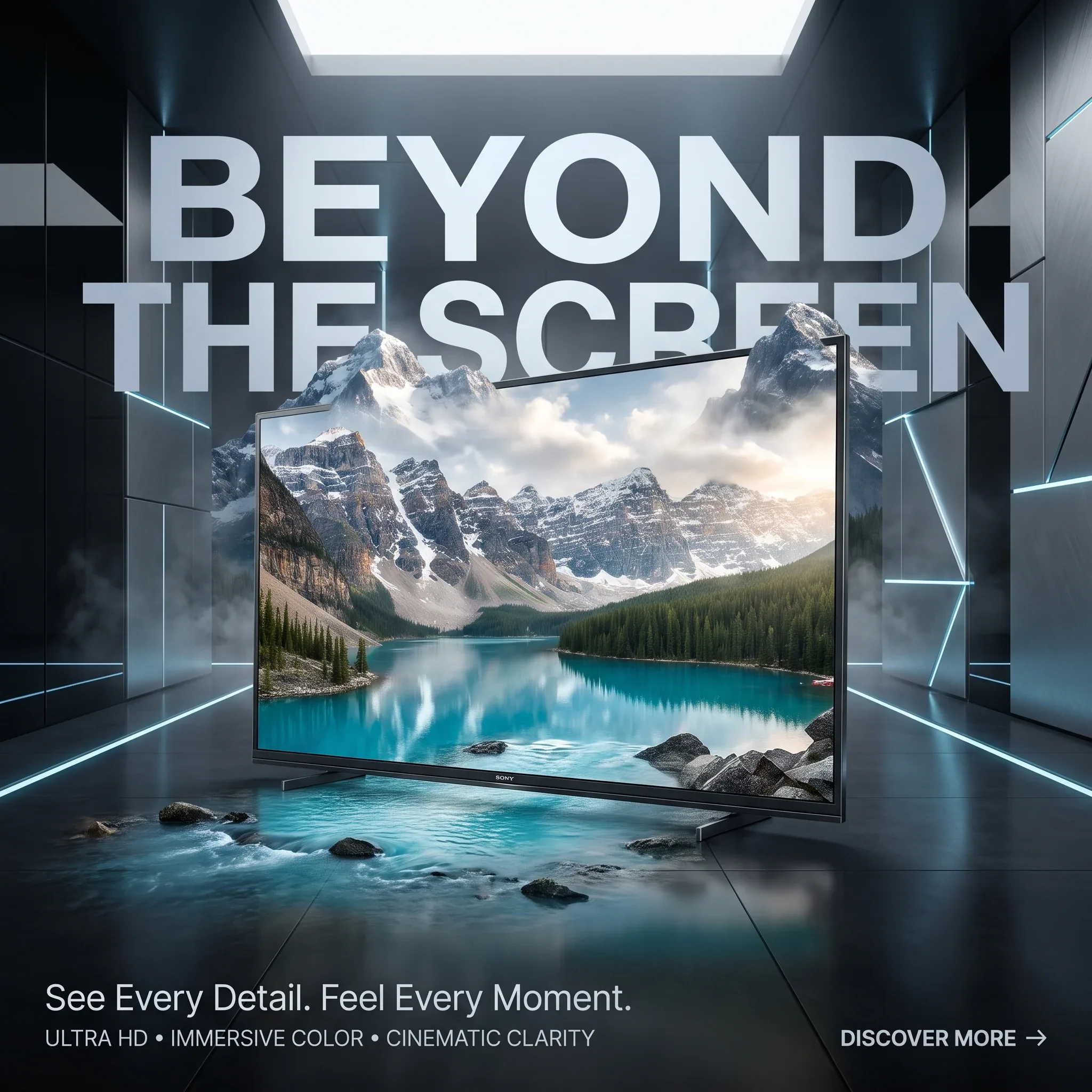
SONY LED TV Futuristic Immersive Advertising Poster AI Image Prompt
Create an ultra-photorealistic 1:1 square premium futuristic commercial advertising poster for a SONY LED TV, a sophisticated global consumer-electronics campaign. Category: Consumer Electronics / Premium Television. Mood: futuristic, immersive, sophisticated, cinematic. Creative direction: industrial precision + conceptual feature visualization. Core idea: “BEYOND THE SCREEN”. The television must be the unmistakable visual hero, presented with extreme industrial-design precision, photorealistic materials, cinematic lighting, architectural scale, and a conceptual visualization of an immersive viewing experience. Visual concept: “THE SCREEN BECOMES THE WORLD”. Place a large ultra-slim premium SONY LED television slightly off-center in a dramatic three-quarter frontal perspective, inside a dark futuristic architectural gallery built from matte graphite metal, black glass, brushed aluminium, subtle reflective flooring, precision-cut geometric walls, and thin architectural light strips. The key conceptual device is the TV display. Inside the screen, show an extraordinarily vivid cinematic landscape: towering snow-covered mountains, a crystal-clear turquoise lake, deep evergreen forests, atmospheric clouds, sunlight breaking through the mountain valley, subtle mist, realistic water reflections, and enormous environmental depth. The image must not remain contained inside the screen. The mountain landscape should appear to physically extend beyond the television display into the advertising environment. A section of the turquoise lake flows seamlessly out from the bottom edge of the screen and transforms into the reflective foreground floor. Small rocks, subtle mist and environmental reflections transition naturally from the digital image into physical space. The mountain formations subtly extend beyond the upper screen boundary, producing the illusion that the display has become a portal into another reality. The transition must be elegant, sophisticated and photorealistic—not fantasy VFX. Visual metaphor: a television so immersive that the boundary between screen and reality disappears. Hero product: premium contemporary SONY LED television with extremely slim bezel, elegant minimalist silhouette, physically believable display proportions, precision-engineered frame, dark graphite/black metallic construction, realistic brushed-metal micro-texture, premium glass display surface, extremely thin edge profile, subtle lower-frame detailing, realistic stand/base if visible, clean cable-free presentation, precise corners, realistic glass reflections, subtle ambient reflections from the environment, and perfect contact shadows. It must look like a real high-end consumer electronics product photographed for a global campaign, never like a generic CGI monitor. Do not invent unusual buttons, speakers, ports or decorative hardware. Typography: integrate giant typography directly into the composition. Behind the television, place an enormous uppercase headline: BEYOND THE SCREEN. Use a massive geometric grotesk sans-serif, similar to Helvetica Neue Black / Gotham Black / Inter Black / Archivo Black. Typography should occupy approximately 30–40% of the composition. Use extremely bold letters with tight professional kerning. Allow sections of BEYOND to disappear naturally behind the television and mountains, creating layered spatial depth. Some oversized letters may extend beyond the square canvas. Typography color: soft white / cool silver with extremely subtle metallic tonality. Do not use bevelled 3D text. The typography remains fundamentally flat, editorial and sophisticated while interacting spatially with the hero product. Copy system: hero headline: BEYOND THE SCREEN. Subheadline: See Every Detail. Feel Every Moment. Feature micro-copy: ULTRA HD • IMMERSIVE COLOR • CINEMATIC CLARITY. Keep feature text extremely small compared with the headline. CTA: DISCOVER MORE →. Minimal typography-based CTA positioned near the lower-right area. Do not use a large generic button. Color palette: Obsidian Black #080A0D, Graphite #181C22, Gunmetal #303740, Metallic Silver #AEB7C2, Soft White #F3F6F8, Midnight Blue #07172B, Electric Blue #087CFF, Cyan Highlight #27D7FF. The surrounding environment should remain predominantly black, graphite and midnight blue. Electric blue and cyan should be used only as controlled technological accents. The television image itself provides the strongest natural color contrast through turquoise water, blue sky, green forest and white mountains. Avoid excessive neon. Environment: sophisticated near-future architectural exhibition space, not a sci-fi spaceship. Use monumental dark architecture, black reflective glass, graphite metal, brushed aluminium, precision-cut wall panels, minimal geometric architecture, thin integrated LED strips, polished dark reflective floor, large negative spaces, subtle atmospheric haze, deep architectural shadows, controlled cyan illumination, premium industrial surfaces. Use strong architectural leading lines pointing toward the television. The environment should communicate: PRECISION + TECHNOLOGY + SCALE + IMMERSION. Camera: ARRI Alexa 35 commercial photography character; lens 35mm; angle slightly low three-quarter frontal hero angle; camera height approximately 70–90 cm above floor level; perspective dramatic but optically believable; framing television dominates approximately 55–65% of the square composition; moderate depth of field; entire television razor sharp while distant architectural elements become progressively softer; no extreme wide-angle distortion. Lighting: premium technology-advertising illumination. Large diffused overhead softbox-style key light producing controlled highlights across the television frame. Add cool blue rim lighting, thin white edge highlights, subtle cyan architectural illumination, controlled reflections on television glass, realistic metallic specular highlights, soft environmental bounce, deep but readable shadows, subtle volumetric atmosphere, realistic floor reflections, accurate contact shadows beneath the television. The landscape emerging from the screen provides a subtle secondary natural light source, casting faint blue daylight onto nearby surfaces. This interaction is critical: light from the screen should realistically affect the physical environment, strengthening the illusion that the digital world is entering reality. No excessive bloom. No artificial neon glow surrounding the entire television. Composition: Foreground: continuation of the turquoise lake as a glossy reflective surface flowing toward the viewer. Include only a few subtle natural elements—perhaps two or three wet stones and extremely light mist—to establish the screen-to-reality transition. Midground: the SONY television is the dominant hero. Position it around the central-left or center-right region rather than mechanically centering everything. The screen portal and television frame remain the strongest focal point. Background: giant BEYOND THE SCREEN typography, dark futuristic architecture, thin architectural illumination, subtle atmosphere, deep shadows, large negative-space zones for supporting information. Industrial precision: every material must feel physically accurate. Television glass: premium optical glass with controlled reflections. Frame: dark anodized aluminium / premium graphite finish. Architecture: brushed metal, matte graphite panels and black glass. Floor: polished dark material with believable reflection falloff. Landscape: genuine photographic realism. Preserve extremely fine micro-details without making the image artificially oversharpened. Graphic design elements: introduce minimal technical graphics: thin horizontal lines, tiny feature labels, subtle alignment markers, restrained micro typography and one or two precision UI-inspired indicators. A thin line can extend from a small feature label toward the edge of the television. Keep approximately 85–90% of the design free from unnecessary graphic decoration. Every element must look deliberately placed by a professional advertising art director. The final advertisement must communicate: IMMERSION + PRECISION + FUTURE + CINEMATIC EXPERIENCE. Ultra-high-resolution 8K appearance, photorealistic commercial product photography, sophisticated global advertising campaign, premium industrial design, realistic optical materials, HDR tonal range, precise perspective, realistic reflections, premium retouching, crisp typography and campaign-ready graphic design. Negative prompt: generic television advertisement, cheap electronics poster, generic stock photography, excessive neon, cyberpunk overload, sci-fi spaceship interior, gaming aesthetic, excessive holograms, excessive particles, excessive lens flare, unrealistic glow, blue glow around every object, cartoon, illustration, digital painting, plastic materials, fake television frame, warped television geometry, curved screen unless specifically intended, incorrect screen perspective, oversized bezels, random ports, fake hardware, distorted architecture, unrealistic landscape, floating mountains without physical logic, excessive typography, multiple competing headlines, warped letters, misspelled text, illegible typography, random logos, clutter, excessive UI graphics, low-resolution textures, artificial sharpening, oversaturation, crushed blacks, blown highlights, unrealistic reflections, floating product, incorrect contact shadows, obvious CGI appearance, obvious AI-generated artifacts.
Content: Formula: 1:1 commercial poster, SONY TV hero, futuristic gallery, screen landscape spilling into reality, giant headline typography, set palette, 35mm camera, cinematic lighting, material precision, 8K ad retouching, negatives.
Pros: Highly complete structure, materials, lighting, typography and negative constraints; clear ad direction.
Cons: Overly dense; many elements may compete. Text-heavy layout and conceptual blend are hard to generate.
Reference image: No obvious reference-image dependency
Source materials are collected from publicly accessible web pages. Contact us if a rights issue needs review. Copyright & Privacy