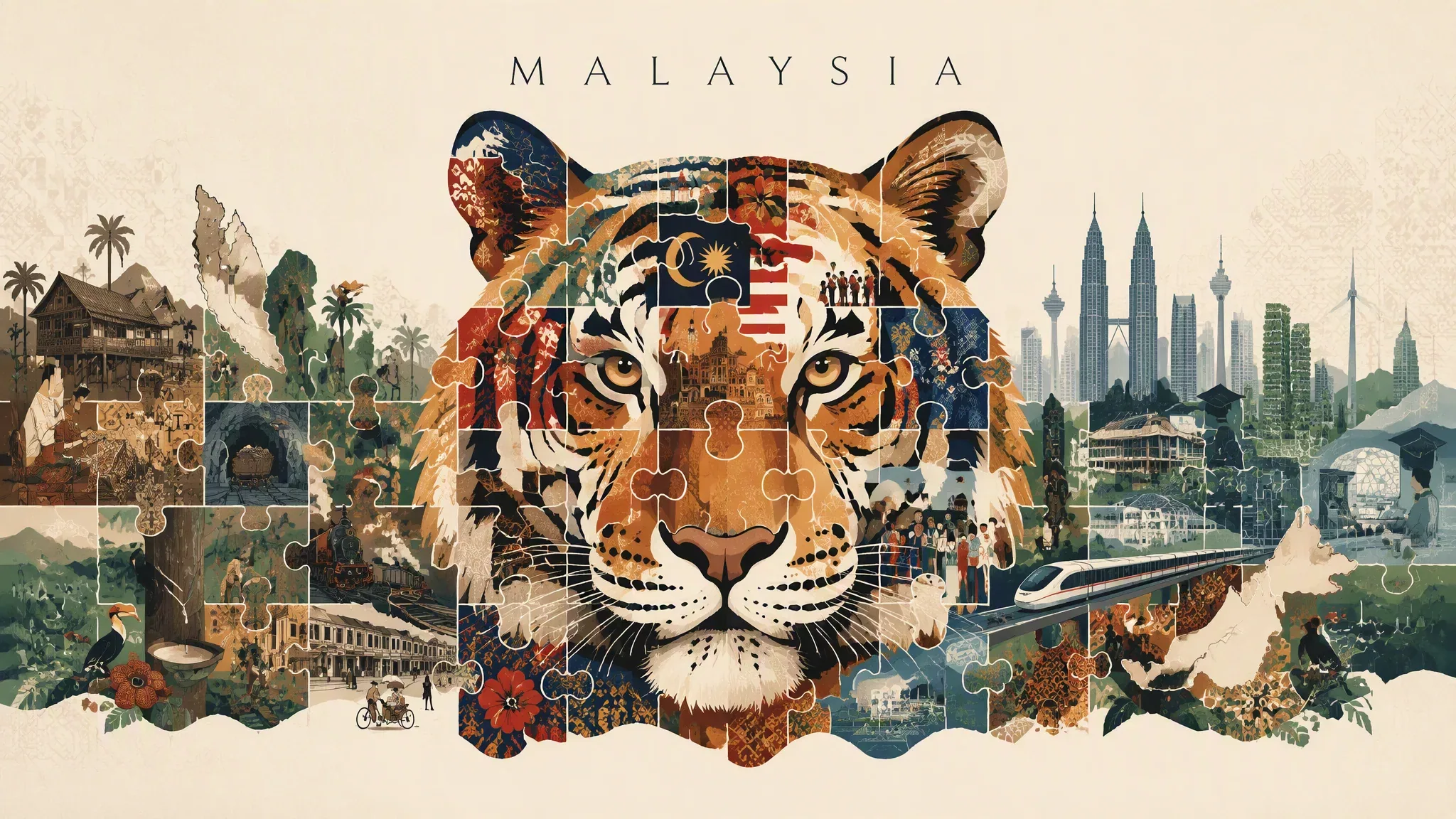
Merdeka Poster: Tiger Made of Malaysian Puzzle Pieces AI Image Prompt
A sophisticated, competition-level landscape Merdeka poster for Malaysia, designed with a professional Canva editorial-poster aesthetic. The entire artwork is based on one strong visual metaphor: MANY PIECES. MANY GENERATIONS. ONE MALAYSIA. A majestic Malayan tiger head is formed entirely from interlocking puzzle pieces. Each puzzle piece represents a different part of Malaysia's journey — heritage, history, independence, culture, unity, development and the future. The puzzle pieces visually connect past generations to present and future generations, showing that Malaysia is continuously built, protected and strengthened from one generation to the next. FORMAT: Landscape orientation. Recommended aspect ratio: 16:9 or approximately 3:2. High-resolution editorial art poster. Wide cinematic composition. Generous negative space. Strong horizontal visual flow. Designed as if it will be refined and arranged in Canva using clean geometric shapes, vector-style illustrations, masks and layered elements. The artwork must remain elegant and readable from a distance. CORE COMPOSITION: Create a large central Malayan tiger head occupying approximately 45–55% of the poster height. The tiger is constructed from approximately 30–45 interlocking geometric puzzle pieces. The tiger must remain clearly recognisable. The puzzle pieces are not random decoration. They form the actual structure of the tiger. Around the tiger, create a horizontal visual journey: LEFT → CENTRE → RIGHT, PAST → MERDEKA → PRESENT → FUTURE. The entire composition should visually feel like Malaysia's story moving forward through generations. LEFT SIDE — ROOTS & OLDER GENERATIONS: On the left side, use smaller puzzle pieces containing simplified Malaysian heritage imagery: kampung houses, traditional wooden architecture, rubber trees, tin-mining heritage, old railway, traditional crafts, batik-inspired patterns, songket-inspired geometry, traditional Malaysian streets, rainforest landscape. Use slightly more organic and traditional geometric forms. These pieces represent the foundations created by previous generations. Do not show a literal timeline. Instead, let the imagery naturally flow toward the centre. CENTRE — MERDEKA & UNITY: The central area becomes the strongest part of the composition. The historical puzzle pieces transition into the Malayan tiger. Subtly integrate: independence-era symbolism, the Malayan flag, Malaysian cultural patterns, historical architecture, symbolic references to 31 August 1957, interconnected communities, the journey toward independence. Do not make the history section look like an infographic. Keep it artistic and symbolic. The puzzle pieces should visually become stronger and more unified as they approach the tiger. TIGER — THE HEART OF MALAYSIA: The Malayan tiger is the central visual hero. Create a powerful, dignified tiger facing forward. Recognisable features: strong forehead, distinctive ears, focused eyes, natural muzzle, characteristic black stripes, realistic Malayan tiger proportions. Approximately 70% natural recognisable form + 30% geometric simplification. The tiger should look elegant and powerful, not aggressive or frightening. The puzzle boundaries should follow the tiger's anatomy. Some puzzle pieces contain historical imagery. Some contain cultural patterns. Some contain Malaysian landscapes. Some contain modern elements. Together they form one complete tiger. RIGHT SIDE — PRESENT & FUTURE GENERATIONS: As the puzzle pieces extend from the tiger toward the right side, transition into contemporary Malaysia. Include subtle geometric references to: Petronas Twin Towers, modern Malaysian skyline, technology, education, sustainable architecture, renewable energy, modern transportation, green cities, rainforest conservation, innovation. The forms should become increasingly clean, modern and geometric. This represents the younger generation carrying Malaysia forward. The final puzzle pieces on the far right should suggest future development without becoming science fiction. GENERATIONAL HANDOVER: Create a visual transition across the entire landscape: LEFT (Traditional heritage and foundations) ↓ CENTRE (Independence, unity and national identity) ↓ RIGHT (Modern Malaysia and the future). The transition should happen through the puzzle pieces themselves. Traditional patterns gradually transform into modern geometry. Old architecture gradually transforms into contemporary architecture. Natural forms gradually transform into sustainable technology. The visual message: The future is built from the pieces inherited from the past. CULTURAL UNITY: Integrate Malaysia's multicultural heritage into the puzzle pieces. Use subtle visual motifs inspired by: Malay batik, songket, Chinese decorative geometry, Indian kolam, Sabah indigenous patterns, Sarawak indigenous patterns, traditional Malaysian crafts, tropical flora. Do not place cultures into separate isolated sections. Instead, allow their patterns to interlock with one another. Different visual languages should physically connect through the puzzle. The message should be: Different pieces. One nation. MALAYSIA MAP: Subtly integrate the recognisable silhouettes of Peninsular Malaysia and East Malaysia into several puzzle pieces. Do not make the map a dominant element. It should be a hidden discovery detail. The map should appear naturally within the puzzle artwork. CANVA-READY DESIGN LANGUAGE: Create the artwork using a clean Canva-friendly visual system: flat vector-style shapes, geometric silhouettes, clean puzzle pieces, simple layered illustrations, editable-looking elements, clear boundaries, consistent spacing, controlled layering, subtle masks, restrained textures, simple shadows only when necessary. Imagine the artwork being constructed in Canva from shapes + vector illustrations + frames + masks + patterns + textures + typography. Major elements should look visually separable and easy to recreate. LANDSCAPE VISUAL FLOW: The viewer's eye should travel naturally: HERITAGE → HISTORY → MERDEKA → TIGER → MODERN MALAYSIA → FUTURE. Do not make every section equally large. The tiger remains the dominant focal point. The left and right sides act as supporting storytelling zones. TITLE: Place only: MALAYSIA at the upper centre. Use: uppercase, thin refined sans-serif, wide letter spacing, small scale, elegant editorial typography. No other text. No slogan. No subtitle. No additional words. COLOUR PALETTE — MERDEKA HERITAGE: Use a sophisticated muted Malaysian palette: deep Merdeka navy, restrained crimson, warm ivory, muted forest green, tropical green, soft ochre, muted terracotta, charcoal black. Keep colours sophisticated and slightly desaturated. Use red and blue strategically. The tiger's black stripes provide strong visual structure. Avoid excessive use of national flag colours. BACKGROUND: Use a calm warm-ivory or very light neutral background. Very subtle geometric Malaysian-inspired patterns may appear behind the main composition. Keep the background quiet. The background must never compete with the tiger. Maintain generous negative space around the main subject. TEXTURE: Apply subtle handmade print qualities: gouache, dry brush, coloured pencil, silkscreen, subtle paper fibre, imperfect pigment edges. Keep the texture sophisticated and restrained. The result should resemble a premium contemporary museum poster. NO aged paper. NO sepia. NO yellowed vintage paper. STYLE: Contemporary Malaysian cultural poster. Scandinavian editorial illustration. Mid-century geometric art. Modern museum-shop print. Sophisticated travel-poster composition. Landmark-led architectural illustration. Premium Canva editorial design. Handcrafted gouache and silkscreen aesthetic. FINAL VISUAL STORY: From far away, the viewer sees: A powerful Malayan tiger. Looking closer: The tiger is made from puzzle pieces. Looking even closer: Every puzzle piece contains part of Malaysia's story. Across the landscape: Past generations → Merdeka → present generation → future generation. The final idea should feel: Malaysia was not built from one piece. It was built from many people, many cultures, many generations and many moments in history — all connected together. The completed puzzle becomes the tiger. The tiger becomes the symbol of Malaysia. STRICT CONSTRAINTS: No portrait-oriented composition. No cartoon tiger. No childish puzzle aesthetic. No random floating puzzle pieces. No excessive abstraction. No photorealism. No 3D rendering. No neon. No metallic gold. No giant circles. No excessive Malaysian flags. No clutter. No excessive text. No additional words. No slogans. No watermark. No logos. No stock-photo appearance. No vintage filter. No sepia. No yellowed paper. No distorted tiger anatomy. No overly aggressive tiger. No unrelated landmarks. No disconnected cultural symbols. The tiger must remain immediately recognisable. The puzzle must remain the primary storytelling mechanism. FINAL CONCEPT: MANY PIECES. MANY GENERATIONS. ONE MALAYSIA.
Content: Landscape poster; central tiger head built from puzzle pieces, left-right narrating past, present, future; includes cultural motifs, hidden map, horizontal flow; demands Canva-editable flat vector style; specifies palette, background, texture, title layout.
Pros: Unified visual metaphor with strong symbolism; detailed composition, color, style, and constraints enhance practicality.
Cons: Many elements may raise production complexity; numerous restrictions could reduce creative freedom.
Reference image: No obvious reference-image dependency
Source materials are collected from publicly accessible web pages. Contact us if a rights issue needs review. Copyright & Privacy