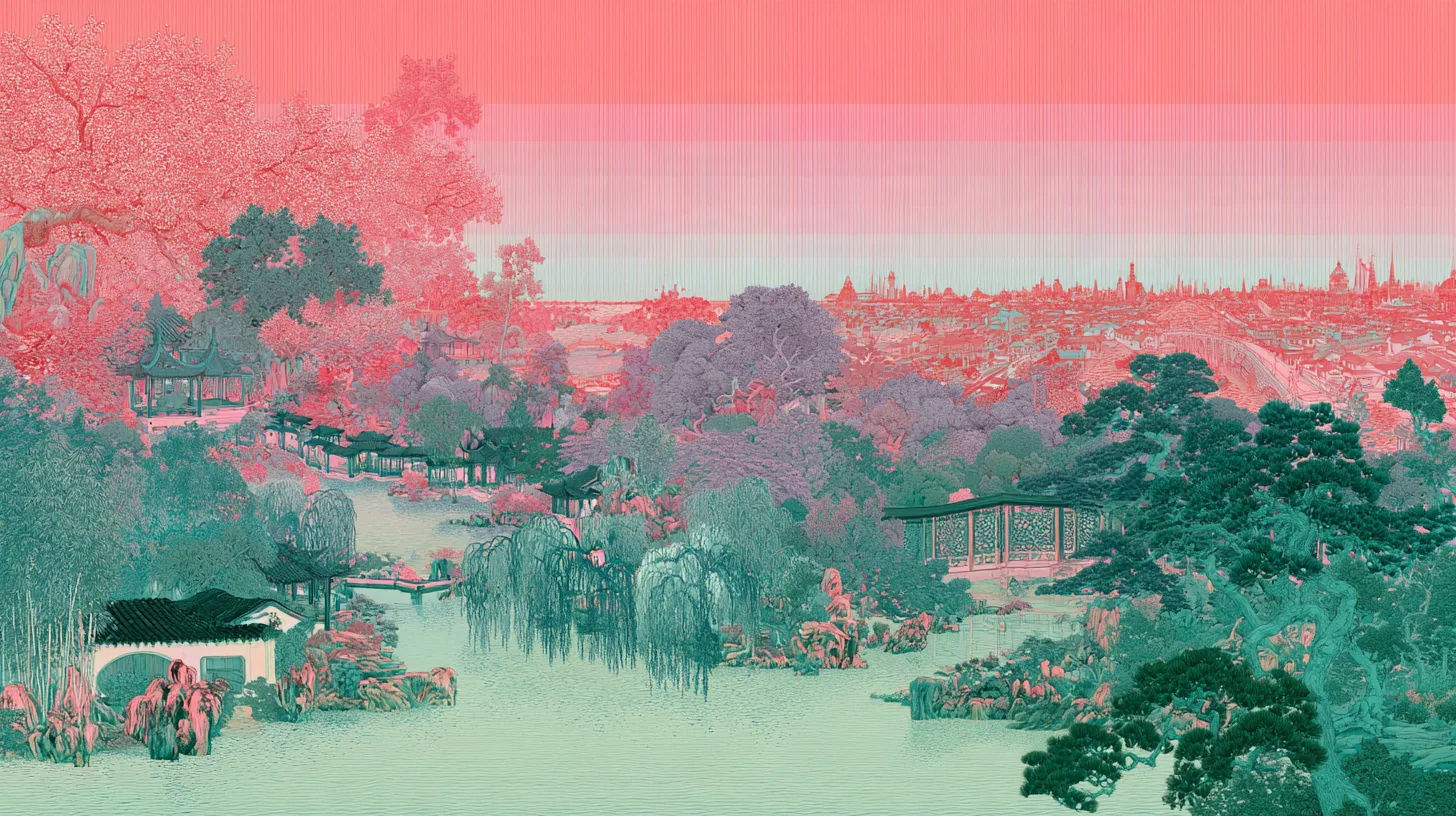
Yangzhou Spring Garden Scroll Key Visual AI Image Prompt
21:9 ultra-wide horizontal tourism project key visual (KV). Strictly follow the reference image's overall visual style, composition approach, line-art treatment, scenery layout, and artistic texture, replacing only the regional elements with Yangzhou-specific elements. The overall piece is a giant Eastern garden scroll-style key visual. The image uses a large-area vertical gradient background: the top is bright, saturated cherry-blossom pink and rose pink; the middle gradually transitions to soft light pink and light cyan; the bottom transitions to clear but distinct mint green. Pink and mint green blend naturally; the gradient should be obvious yet delicate, not too gray-white, not desaturated to near white. The overall color should be bright, vivid, visually striking, while maintaining a premium feel. All scenery in the image must uniformly use 'monochrome dark line art' treatment. Absolutely do not fill the scenery with color; no colored illustration, no color blocks, no realistic coloring. Line-art color changes naturally according to background area: in pink background areas, use deeper rose pink, rouge pink, deep cherry pink line art; in the middle, use deep pink-purple and gray-cyan line art; in mint green background areas, use deeper mint green, cyan-green, and deep cyan-green line art. The line art and background belong to the same color family, but are clearly 2–3 levels darker than the background, forming a clear, rich, layered visual effect. Strictly reference the original image's Eastern garden line-drawing expression, using very refined, fine, continuous Chinese traditional garden gongbi line drawing; lines are slender but clear, with rich detail variation. Increase overall line-art density, so the left and right sides, upper edges, and distant areas have richer garden line art; do not have only a few scattered trees and buildings. Scenery should naturally overlap, interweave, and occlude, forming rich scroll-style spatial layers, but not be cluttered. The left side focuses on integrating Yangzhou Slender West Lake and garden elements: weeping willows, Five Pavilion Bridge, classical pavilions, winding bridges, waterfront, Taihu stones, bamboo branches, classical garden architecture, white walls and dark tiles, flying eaves, ornamental windows, corridors, etc., unfolding layer by layer in fine line art. The right side integrates Yangzhou gardens and ancient city elements: classical pavilions, winding corridors, white walls and dark tiles, leaky windows, ornamental windows, bamboo groves, pine trees, Taihu stones, ancient bridges, waterfront, a small amount of spring flower branches, and can subtly incorporate representative Yangzhou imagery such as the Twenty-Four Bridge. Tree and plant line art should be richer; trunks, canopies, willow branches, and bamboo leaves all rendered with fine lines, forming the lush yet light Eastern garden plant effect in the reference image. You may add some small branches and leaves, distant tree clusters, rocks, water ripples, and architectural details, making the entire image's line art fuller. Water surfaces use extremely fine same-color-family line art; you may add fine water ripples, reflections, and distant shoreline lines, but no large areas of solid color. Buildings also all use line art only, no white fill, no color fill; use only line density to express distance and layers. Composition strictly adopts the reference image's 'left and right landscape expansion + large central negative space' format. The left and right sides are relatively full of scenery, and some trees and architecture line art also naturally extend into the image from the upper edge. The central area remains open, forming complete visual breathing space. Do not let any large scenery, bridge, tree, or building occupy the central core area. The central negative space is for adding tourism project theme text in post-production. The overall line art should be clearer, richer, and fuller than the reference image, but still light and refined. Do not make it a traditional ink painting; do not blur, do not make it transparent or faded, do not use gray, murky line art. It should have a refined texture similar to a high-end commercial art installation, Eastern garden art scroll, and fashion brand key visual. Overall image keywords: high-end Eastern garden scroll, Yangzhou spring, Slender West Lake, Five Pavilion Bridge, Twenty-Four Bridge, Yangzhou gardens, white walls and dark tiles, weeping willows, bamboo groves, Taihu stones, winding corridors, ancient bridges, fine gongbi line art, same-color-family dark line art, pink-to-mint-green gradient, bright and vivid, high-end fashion, rich line art, full but not chaotic, central negative space, horizontal scroll composition. Prohibited: no coloring scenery, no colored buildings, no colored plants, no ink wash diffusion, no 3D, no realistic photography, no cartoon, no flat vector, no modern architecture, no people, no text, no Logo, no China-chic patterns, no auspicious clouds or dragons/phoenixes, no excessive gold, no filling the center with elements, no overly faint line art.
Content: Formula: 21:9 horizontal KV; follow reference style, composition, line art, layout; replace region with Yangzhou; vertical pink-to-mint gradient; monochrome dark same-family line art; side scenery plus central negative space; prohibitions.
Pros: Clear structure: style, color, composition, and negative prompts are complete; region replacement and central text space are explicit.
Cons: Heavy reference-image dependency; too many constraints create tension and make generation difficult.
Reference image: Clearly depends on reference image/original image; requires an uploaded reference.
Curated from publicly available creative examples. Prompts and commentary are edited and organized by this site. Please contact us with any rights concerns. Copyright & Privacy